Category Theory 2026
2026-07-17
$$
% https://tex.stackexchange.com/a/269194
$$
In “Yoneda theory for double categories,” Paré (2011) identifies:
Notion of “double (co)presheaf” capturing the (tight) Hom functor
\[ \operatorname{Hom}_{\mathbb{D}}: \mathbb{D}^\mathrm{op}\times \mathbb{D} \xrightarrow{\mathrm{lax}} \mathbb{S}\mathsf{et}\ (= \mathbb{S}\mathsf{pan}) \]
Receiving structure for a (tight) Yoneda embedding
\[ Y_{\mathbb{D}}: \mathbb{D} \to \mathbb{L}\mathsf{ax}(\mathbb{D}^\mathrm{op}, \mathbb{S}\mathsf{et}), \]
namely the VDC \(\mathbb{L}\mathsf{ax}(\mathbb{D}^\mathrm{op}, \mathbb{S}\mathsf{et})\) of set-valued lax functors, natural transformations, modules, and (multi)modulations.
Tight Yoneda theory also works with normal lax functors valued in \(\mathbb{C}\mathsf{at}\) (Fröhlich and Moser 2024).
The (tight) Hom functor on a double category \(\mathbb{D}\) is a lax double functor
\[ \operatorname{Hom}_{\mathbb{D}}: \mathbb{D}^\mathrm{op}\times \mathbb{D} \to \mathbb{S}\mathsf{et} \]
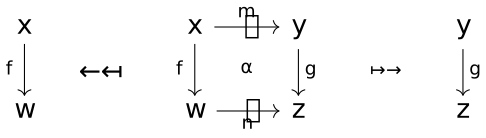
that sends
a pair of loose morphisms \((m, n)\) to the span with apex \(\mathbb{D}_1(m,n)\):
So, we know that a “tight copresheaf” is a set-valued lax double functor.
Question: What is a “loose copresheaf” or “loose module” on a double category, i.e., an action by loose morphisms?
Applications, present and future:
Problem: No existing structure directly captures data of “loose copresheaf”.
Using the transpose with ordinary notion of double functor
\[ \mathbb{D}^\top \xrightarrow{\text{lax}} \mathbb{S}\mathsf{et} \qquad\leftrightsquigarrow\qquad \mathbb{D}^\top \xrightarrow{\scriptscriptstyle{\text{normal lax}}} \mathbb{C}\mathsf{at} \]
does not make sense unless \(\mathbb{D}\) is strict.
Strategy:
Lots of equivalent ways to formalize “module over a category \(\mathsf{C}\)”:
| Name | Notation |
|---|---|
| copresheaf | \(F: \mathsf{C} \to \mathsf{Set}\) |
| discrete opfibration | \(P: \mathsf{E} \to \mathsf{C}\) |
| algebra of pull-push monad | \(A: E \times_{\mathsf{C}_0} \mathsf{C}_1 \to E\) |
| barrel (one-sided) | \(M: \mathsf{M} \to \{0 \to 1\}\) (s.t. \(M^{-1}(0) = \mathsf{1}\), \(M^{-1}(1) = \mathsf{C}\)) |
The pull-push monad is a monad on \(\mathsf{Set}/\mathsf{C}_0\). The term “barrel” is due to Joyal.
A “loose copresheaf on a double category \(\mathbb{D}\)” can be formalized as:
| Name | Notation |
|---|---|
| twisted copresheaf | \(F: \mathbb{D} \looparrowright\mathbb{C}\mathsf{at}\) |
| (cloven) loosely discrete opfibration | \(P: \mathbb{E} \to \mathbb{D}\) |
| pseudo-algebra of pull-push pseudo-monad | \(A: \mathsf{E} \times_{\mathbb{D}_0} \mathbb{D}_1 \to \mathsf{E}\) |
| double barrel (one-sided) | \(M: \mathbb{M} \to \mathbb{L}\mathsf{oose}\) (s.t. \(M^{-1}(0) = \large\unicode{x1D7D9}\), \(M^{-1}(1) = \mathbb{D}\)) |
Plan:
Examine the canonical example, the twisted Hom functor
\[ \mathbb{D}(-,=): \mathbb{D}^\mathrm{co}\times \mathbb{D} \looparrowright\mathbb{C}\mathsf{at}\]
State definition of twisted double functor
\[ F: \mathbb{D} \looparrowright\mathbb{E} \]
Construction (sketch). The twisted Hom functor on a double category \(\mathbb{D}\) is a twisted normal lax functor
\[ \mathbb{D}(-,=): \mathbb{D}^\mathrm{co}\times \mathbb{D} \looparrowright\mathbb{C}\mathsf{at}\]
that sends
a pair of loose morphisms \((p: x' \mathrel{\mkern 3mu\vcenter{\hbox{$\scriptstyle+$}}\mkern-13mu{\to}}x,\ q: y \mathrel{\mkern 3mu\vcenter{\hbox{$\scriptstyle+$}}\mkern-13mu{\to}}y')\) to the functor
\[ \mathbb{D}(p,q) \mathrel{\vcenter{:}}=p \odot (-) \odot q: \mathbb{D}(x,y) \to \mathbb{D}(x',y') \]
acting by loose composition
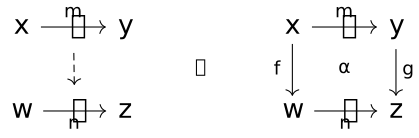
a pair of tight morphisms \((f: x \to w,\ g: y \to z)\) to the profunctor
\[ \mathbb{D}(f,g): \mathbb{D}(x,y) \mathrel{\mkern 3mu\vcenter{\hbox{$\scriptstyle+$}}\mkern-13mu{\to}}\mathbb{D}(w,z) \]
with heteromorphisms
and actions by pre-/post-composing with globular cells
…and encodes the remaining data of \(\mathbb{D}\) as follows:
| Encoding from \(\mathbb{D}\) | Data in \(\mathbb{D}(-,=)\) |
|---|---|
| Loose composition of cells in \(\mathbb{D}\) | Mapping from pairs of cells in \(\mathbb{D}\) to natural transformations |
| Tight composition of cells in \(\mathbb{D}\) | Tight-to-loose composition comparisons |
| Associators and unitors of \(\mathbb{D}\) | Loose-to-tight composition and identity comparisons |
Takeaways:
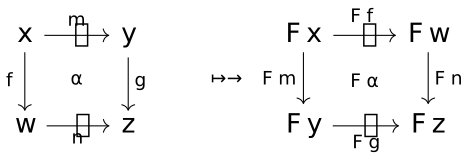
Definition (sketch). A twisted lax functor \(F: \mathbb{D} \looparrowright \mathbb{E}\) sends
a cell \(\alpha\) of \(\mathbb{D}\) to a cell \(F\alpha\) of \(\mathbb{E}\) of transposed shape:
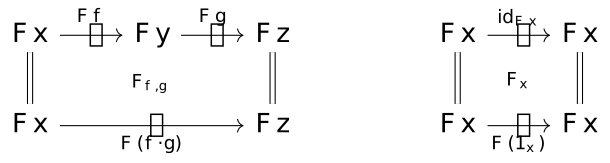
and contains the following comparison cells…
tight-to-loose composition and identity comparisons
loose-to-tight composition and identity comparisons
assumed to be invertible (w.r.t. loose composition).
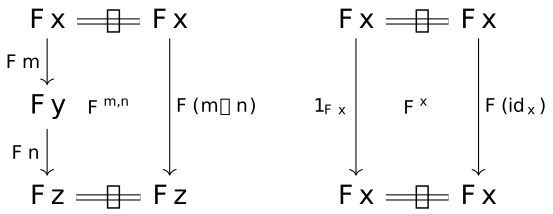
…finally, these cells satisfy the expected coherence axioms (omitted).
Definition. A twisted lax functor is normal if the tight-to-loose identity comparisons \(F_x\) are invertible (w.r.t. tight composition).
Twisted normal lax functors are the primary notion. In particular:
Definition. A twisted copresheaf on a double category \(\mathbb{D}\) is a twisted normal lax functor \(\mathbb{D} \looparrowright\mathbb{C}\mathsf{at}\).
Examples of twisted representables:
For a finitely complete category \(\mathsf{C}\), self-indexing is representable:
\[ \mathbb{S}\mathsf{pan}(\mathsf{C})(1, -): \mathbb{S}\mathsf{pan}(\mathsf{C}) \looparrowright\mathbb{C}\mathsf{at}, \quad x \mapsto \mathsf{C}/x \]
For a regular category \(\mathsf{C}\), subobjects are representable:
\[ \mathbb{R}\mathsf{el}(\mathsf{C})(1, -): \mathbb{R}\mathsf{el}(\mathsf{C}) \looparrowright\mathbb{C}\mathsf{at}, \quad x \mapsto \mathsf{Sub}(x) \]
Plan:
Recall the notion of discrete opfibration for internal categories
\[ P: \mathsf{E} \to \mathsf{B} \]
Weaken for internalization in \(\mathbf{Cat}\), yielding a loosely discrete opfibration
\[ P: \mathbb{E} \to \mathbb{B} \]
Introduce cleavage needed due to weakening:
\[ \sigma: \mathbb{E}_0 \times_{\mathbb{B}_0} \mathbb{B}_1 \to \mathbb{E}_1 \]
Let \(\mathsf{C}\) be a category with pullbacks.
Definition. A functor \(P: \mathsf{E} \to \mathsf{B}\) internal to \(\mathsf{C}\) is a discrete opfibration if the canonical map \(\langle d_0, P_1 \rangle\) is an isomorphism:
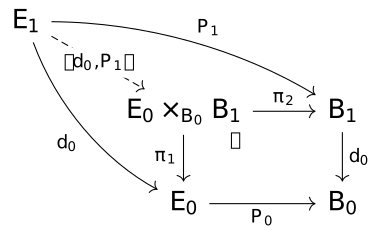
Problem: Naively instantiating in \(\mathsf{C} = \mathsf{Cat}\) asks that \(\langle d_0, P_1 \rangle\) be an isomorphism of categories—too strict!
For internal discrete opfibrations, see e.g. Johnstone (2002, sec. B2.5).
Definition. A double functor \(P: \mathbb{E} \to \mathbb{B}\) is a loosely discrete opfibration (ldopf) if the canonical functor \(\langle \operatorname{src}, P_1 \rangle\) is an equivalence of categories:
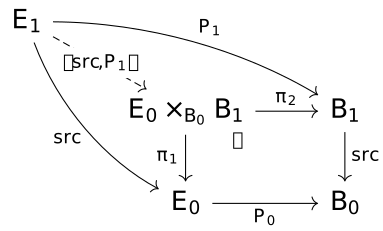
Fact. \(P\) is locally discrete in the loose direction: each fiber \(\mathbb{E}_x \mathrel{\vcenter{:}}=P^{-1}(x)\), \(x \in \mathbb{B}\), is (equivalent to) a loosely discrete double category.
Definition. A cleavage for an ldopf \(P: \mathbb{E} \to \mathbb{B}\) is a functor
\[ \sigma: \mathbb{E}_0 \times_{\mathbb{B}_0} \mathbb{B}_1 \to \mathbb{E}_1 \]
that is left-adjoint-right-inverse (LARI) to the canonical functor \(\langle \operatorname{src}, P_1 \rangle\)
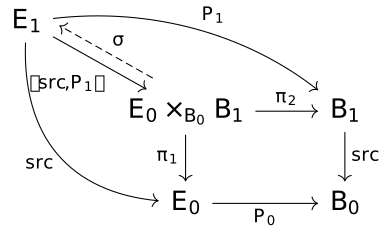
along with
a pseudo-algebra of the pull-push pseudo-monad given by \(\mathbb{B}\), having carrier and structure map
\[(P_0: \mathbb{E}_0 \to \mathbb{B}_0,\ \operatorname{tgt}\sigma: \mathbb{E}_0 \times_{\mathbb{B}_0} \mathbb{B}_1 \to \mathbb{E}_0)\]
coherently with the counit \(\varepsilon\) of the adjunction \(\sigma \dashv \langle \operatorname{src}, P_1 \rangle\).
Cf. LARI characterization of opfibrations of categories (Gray 1966, Prop. 3.11).
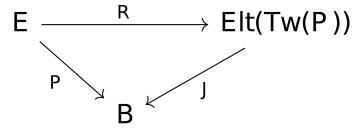
Theorem. For any double category \(\mathbb{B}\), there is a correspondence

in which the forward direction is an elements construction.
To be precise, these constructions round-trip, up to:
for each cloven ldopf \(P: \mathbb{E} \to \mathbb{B}\), an equivalence of double categories over \(\mathbb{B}\)
We have defined natural transformations between twisted functors (and modifications between those).
Further reading: “Twisted double functors and loosely discrete opfibrations” (Lambert et al. 2026) at arXiv:2607.06823.
![]()